Wednesday, October 12, 2011

Being Present: Reflections on Catalyst 2011

Catalyst 2011, a conference geared towards emerging Leadership (primarily Christian), had the theme: BE PRESENT. My first thought when hearing the theme for this conference I would attend with some of my co-workers was: how cliché and trendy. Yes, in a world filled with 24-hour news, smart phones, and social media, to revolve a conference around “being present” was a pretty easy target. Yet no matter how easy the target, was still a message I needed to hear and I am guessing most people that attended needed to hear.

As primarily a visionary leader who lives a lot of life in the abstract and future, I really needed this conference to help recalibrate me. I needed to hear other accomplished visionaries and leaders say that “being present” was important. I was not disappointed. Like I mentioned, I live primarily in the future. I am always thinking about the next step. Planning. Coordinating. Detailing every singe move and possible outcome. This has actually hindered me at times in my ability to truly lead because I either become uber-focused on the task (at the cost of people) or when the path gets blown up I am left paralyzed in knowing how to move forward.

I have looked ahead for the next big opportunity, passing by the ones right in front of me.
I have looked ahead for the time Judah would take his first step when he was just starting to crawl.
I have looked ahead to the trip to the restaurant when I was eating at home.
I have looked ahead to retirement savings while passing by the guy who could have used a few bucks today.
I have looked ahead to Asia while still living in Philly.

I live a lot of my life in the future.

I realized at this conference just how big of an issue this has been in my life. My work. My family. My friends. My growth and development. My call. All of it. I am always looking to the future.

There were many brilliant aspects to Catalyst. I heard from seasoned leaders of the church, non-profits, and major businesses to grassroots innovators and a 21-year old single woman who has adopted 14 African children…and everyone in between on effective leadership. Maybe I will blog about all of that…but the earth moving point for me as it has to do with this particular idea of “being present”, the most impactful moment of the entire conference was this…

One of the speakers, shared about a young man who was electrocuted in a baptismal during a Sunday church service. This man’s future plans, whatever they might have been, were at that moment dashed. The speaker shared what was to be the sermon the man was going to give after the baptism. It was about “being present”. There were references to loving those in front of you now, doing the little things now, and various pleas like that…but the one line that stays with me was the line that had most to do with my situation. This line was this: “Wipe the nose of your 3-year old, because one day he will wipe it himself.” I just about cried….I think you get the point.

Jesus says, “Do not worry about tomorrow, for tomorrow will worry about itself.” He also says that we don’t know the future and to live for the day. There is a lot that could be said about passages along these lines of “living for the day”. I will save the exegesis and just note that Jesus says this (above) right after he talks about taking care of others first, not storing up treasures on earth (i.e. wealth), and not worrying about our lives in what we will eat, drink, or clothing we will wear (all basic necessities).  Jesus says this to highlight that He will provide (for basic needs, not necessarily luxurious desires), and that truly only He can provide for us and the world. He says this to get us present in the day, because we are not promised tomorrow. So why live in the future. We may not have it. Jesus is beckoning us to be fully present in the day. It is there that we will find Him. It is there that transformation of ourselves and our world happens, when we are totally engaged in the here and now. Totally invested and vested in now.

I come home from Catalyst a changed man. I come home to wipe my 3-year old’s nose. 

Saturday, October 01, 2011

Global Economic Justice (Scott Bessenecker)


Scott Bessenecker is the director of InterVarsity's Global Projects and Global Urban Treks. He has written numerous books that have impacted my life and calling, including, "The New Friars: The Emerging Movement Serving the World's Poor", "How to Inherit the Earth: Submitting Ourselves to a Servant Savior", and "Quest for Hope in the Slum Community: A Global Urban Reader" to name a few. He blogs at the Urbana site. 
When God gave instructions in the Old Testament for the flourishing of his people, he laid out not only moral and ceremonial laws but civic laws as well, including specific economic principles that would characterize his people. The economic laws God established were designed to keep the gap between rich and poor very small. It included debt forgiveness on a seven year cycle and a radical redistribution of land every fifty years. He meant for the leaders of his people to insure that the poor were protected and cared for and not taken advantage of. There were strict penalties for exploitation of the poor and dire warnings of his judgment should these laws be ignored. In fact, it is as easy to trace God’s judgment of Israel to the exploitation of the poor and vulnerable as it is to the worship of foreign gods.
Isaiah 3:13-15

The LORD takes his place in court;
he rises to judge the people.
The LORD enters into judgment
against the elders and leaders of his people:
“It is you who have ruined my vineyard;
the plunder from the poor is in your houses.
What do you mean by crushing my people
and grinding the faces of the poor?”
declares the Lord, the LORD Almighty.
Israel disregarded the economic laws of God, they enslaved others, paid unfair wages, allowed the rich to accumulate land and disregarded the cry of the poor, therefore God sent them into exile. In fact the number of years of exile correspond to the number of sabbatical years that Israel ignored.

THE JEW AND THE GENTILE

This expectation that Israel would operate an economy which was good for the poor did not only apply to the “insider,” the poor Jew. The foreign, non-Jew living in Israel is singled out by God in the Old Testament law to be especially careful not to exploit. That is to say God is not only concerned with the economic well-being of his people, but for those Gentiles among his people.
God, in fact, told Abraham that his intention was for Israel to be a blessing to all nations. God’s flourishing State would not only reveal his character and glory as his people lived out a standard of justice and economic health, but this flourishing would spill over to surrounding nations. Even in exile God commanded his people in Jeremiah 29 to seek the prosperity of their enemy, for in the prosperity of Babylon, they would find their own prosperity.
So the flourishing of the nations would be advanced by an obedient Israel and God’s judgment would be aroused by Israel’s disregard for economic justice.
It is not only God’s people who are judged for injustice, oppression and exploitation. Both Jonah and Nahum preach against the evil of Nineveh, capital of the ancient Assyrian Empire. It was a city of incredible wealth gained through violent warfare, slavery and oppressing a class of serfs who kept the elite in finery. God’s judgment (not just of his people but his judgment of the nations) is a picture of his white hot passion for those who are economically excluded and exploited.
Even in the New Testament, James writes to believers in his epistle that the rich should weep and wail because the wages withheld from the laborer had reached the ears of the Lord. The simple fact is that God will judge and oppose those who exploit the poor – whether they know him or not.
God’s “will on earth as it is in heaven” does not include hundreds of millions suffering malnutrition while hundreds of millions suffer obesity. It does not include nine year old girls who are forced by to lie down underneath ten men a day just so their families can eat. And it does not include men and women made in his image who labor 12 or more hours a day and are still unable to earn enough to live on. This is not a picture of “his kingdom and its righteousness.”

ECONOMICS UNTETHERED

In 1972 the University of Chicago dropped the requirement for a history of Economics course for its graduate students of Economics believing that Economics is a hard science and has little to do with the humanities. Many others followed suit. This shift marked the conclusion of hundreds of years of the field of Economics drifting away from its relationship to philosophy, sociology, or ethics and becoming what it is today – mathematical utilitarianism: the multiplication of wealth without regard to what is just and good and fair for all.
The results of this divorce of ethics from economics can be seen in the US debt crisis as well as the ballooning gap between rich and poor. We have taken Economics out of the school of the Humanities and in so doing we’ve made the field less humane. We have given our governments and banks and corporations freedom to multiply and spend wealth without any ethic.
For those who are in right relationship to the Creator of the universe, for those who have the mind of Christ, for those who are filled with the Holy Spirit, there is a responsibility to strive for the just rule of God on earth even before our own welfare. Economic justice is a sign of the kingdom of God, which is why news of this kingdom is so good to the poor.

HOW SHOULD WE THEN LIVE?

So where is the “plunder of the poor” today? Is it in our houses, the houses of both believers and unbelievers (after all, judgment must begin with the house of God – I Peter 4:17)? Is it in our wardrobes or our retirement accounts? What does it mean for us to adopt God’s heart for the poor and to strive for kingdom righteousness in our world? What does it mean for us to suffer as a result of pressing these kingdom issues in a twisted world?
For the IFES student movement in Sierra Leone, it has meant graduates giving one or two years of voluntary service in poor rural communities, taking jobs in education or health care that few others want. For some InterVarsity US students it has meant saying no to the American dream of a large home and multiple cars and moving into the high crime, high poverty neighborhoods of US cities or slum communities of the developing world. In making their homes among the marginalized, these young graduates have not only seen many come to know Jesus and helped to usher in kingdom change to their neighborhoods by adding their voices to the voices of their poor friends, but they have encountered deep transformation in their own walk with Christ. It has been an act of worship and an experience of sanctification.
For others it has meant moving into the halls of economic power to stand up for the excluded. Dr. Marek Panfil is a graduate of the Warsaw School of Economics and came to Christ as a student. He was worried that to be a faithful Christian might not be compatible with his pursuit of economics, that he should pursue more noble, spiritual causes.
Then, in Romans 16 Marek came across Erastus, the Treasurer for the city of Corinth who sent his greetings to the brothers and sisters in Rome. Here in the Bible was a high ranking economic official. Perhaps his faith might apply to his field. Marek, has a very strategic role in the economics of copper and silver in the country of Poland. His Christian faith allows him to challenge a debt mentality among corporate and government leaders and to champion corporate social responsibility. He is striving to see kingdom righteousness brought to bear in the economics of metal.
Which of us are willing to strive for the kingdom as residents inside the neighborhoods of the poor, forsaking the good life as defined by your culture? Which of us are willing to strive for the kingdom inside the boardrooms and government offices of the powerful, forsaking bribes, corruption and the lure of wealth?
We as believers must bring the redeeming message of Christ’s salvation to rich and poor, turning men and women from evil and selfishness and calling wickedness to account. We must walk alongside those who are uneducated, marginalized and oppressed and those who are educated, powerful and oppressors (whether witting or unwitting). We must seek kingdom justice both at the level of the human heart and the level of the city treasury, presenting to the world an economic ethic that reflects a just God and his righteous kingdom.

Saturday, September 17, 2011

Friday, September 16, 2011

My Ministry Call: Becoming a Voice

Video by InterVarsity on the rich/poor gap. This is part of my call to ministry. This is my passion. And as you will see at the end of the video, it our Maker's as well. Becoming a Voice.


Global Economic Justice from InterVarsity twentyonehundred on Vimeo.

Wednesday, September 14, 2011

More (Helpful) Reflections on 9/11 (Dan Clendenin)

Dan Clendenin writes at www.journeywithjesus.net.


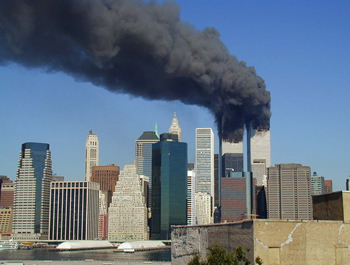
A month ago my wife and I were in New York City and went to the World Trade Center site. Standing there and contemplating what happened made the hair on my neck and arms stand up. America will never forget the trauma of the 9/11 tragedy, nor should we. Ten years later people still remember where they were when they heard the news. I was badgering my son to turn off the television and get to school. He said that something really bad was happening on CNN.


On September 11, 2001, nineteen Al-Qaeda terrorists hijacked four commercial airliners in a coordinated suicide attack. One plane slammed into the North Tower of the WTC, another into the South Tower, a third one plowed into the Pentagon, and a fourth plane that had targeted the US Capitol or the White House crashed in rural Pennsylvania after passengers wrestled control from the hijackers. Nearly 3,000 people from 90 countries died in the carnage, including 343 firefighters and 60 police officers. Although he first denied any responsibility, on October 30, 2004, Osama bin Laden said that he had directed the attacks.

National tragedy.
National tragedy.
Why did Al-Qaeda attack America? How should Christians respond? Ten years is a long time, but it still might not be long enough to understand the tragedy. Preaching at the National Cathedral after the event, Billy Graham observed that no one really knows why such catastrophic evils happen. What follows, then, are a range of reflections more than an adequate explanation.
Throughout history, nations and non-state actors have justified their wars with all sorts of rationalizations — territorial expansion, retaliation, protection, self-defense, and to spread their economic and political ideology. America is no exception in this regard (see Stephen Kinzer's book Overthrow). The thirty-three page National Security Strategy of 2002, for example, praised American democratic capitalism as the "single sustainable model for national success," and "right and true for every person in every society." We would export our way of life "to every corner of the globe," said the NSS, and we'd act unilaterally and preemptively against any nation that tried to thwart us. Needless to say, some countries didn't like such hubris.
The attackers were partly motivated by their hatred of western values — secular democracy that separates church and state, religious pluralism, freedom of speech, freedom to vote, the privacy of the individual, and toleration of dissent. For Muslim extremists and conservative Americans this tends to be a black-and-white view of the world with little middle ground or ambiguity. Nations are "either for us or against us," Bush famously said. On one side there's an "axis of evil" that wills us harm, and on the other side enlightened people who champion the true, the good, and the just. I don't find this view helpful; the "Arab Spring" shows that many Muslims aspire to some western values.
Other people point to American foreign policy. A 1998 fatwa by Osama bin Laden and others objected not to our values but to three specific "crimes and sins" — our support for the United Nations sanctions against Iraq (1990–2003) that hastened the deaths of a million citizens (UNICEF says that 500,000 children died as a result of the sanctions), our biased support for Israel to the detriment of Palestinians, and the presence of our numerous military bases in their sacred Muslim lands. The fatwa also mentioned America's plundering of Arab resources, support for abusive regimes, and undermining self-determination by dictating policy.
In this view, the 9/11 attacks were a classic case of "blowback." Blowback, said Chalmers Johnson, is "another way of saying that a nation reaps what it sows." What many people "hate" about America, Johnson argued, is our global militarism and predatory economic policies which virtually assure retaliations against us for decades to come. Instead of acting prudently, we have acted with what has become predictable condescension towards other nations and with myopia about the consequences. Our overwhelming and global military-economic threat, exercised with little fear of retaliation, is "seeding resentments that are bound to breed attempts at retaliation."
These are reasonable explanations, but they're not a valid excuse. There's no excuse for Al-Qaeda's global terrorism.
Some Christians appealed to God's providential intervention. Jerry Falwell infamously construed the 9/11 attacks as divine punishment for the wickedness of pagans, abortionists, feminists, gays, lesbians, the ACLU, and People for the American Way. “I point the finger in their face,” said Falwell, “and say, ‘you helped this happen.’” Pat Robertson, a guest on the show, nodded in agreement, saying, “well, I totally concur.” In their view, America's policies aren't wrong because they're politically imprudent as a matter of practice. Rather, they're morally wrong as a matter of principle because they violate God's standards.
The remarks of Falwell and Robertson are reckless and hateful. I'm uncomfortable with linking divine judgment and national disaster, whether for America or for any nation. It's one thing to affirm that God acts in the history of nations, but quite another to claim to know exactly how, when, where, or why. And yet, having said that, no less than Abraham Lincoln once described the Civil War as God's judgment on American slavery.
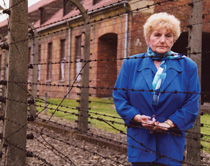
Eva Kor returns to Auschwitz.
Christians face particular difficulties in deconstructing the attacks. The kingdom of God and the kingdoms of the world are different. Personal spiritual truths in the Bible do not translate into national public policies for a country. Dietrich Bonhoeffer described this dilemma during the Nazi horrors. In a letter to Reinhold Niebuhr he said that "German Christians faced a terrible alternative of either willing the defeat of their nation in order that Christian civilization may survive or willing the victory of their nation and thereby destroying civilization." The good of the gospel and the glory of a nation often collide, for if Jesus is Lord, then all the pharaohs and caesars of the world are not lord.
Maybe America is somehow exceptional in the world? Yes and no.
In terms of economic, political, military, scientific and cultural influence, America is unrivaled. In that sense, it's accurate to say that America is "exceptional," although there's no reason to think this will last forever, or that all our influence is good. But since Christian identity is ultimately spiritual and not political or national (Philippians 3:20), from a Christian point of view America is no more or less "exceptional" in God's eyes than Iceland, India, or Iraq. The historian Rebecca Lyman observes that the early gospel developed in the context of Greek, Roman, and Jewish "exceptionalisms," and has ever since been tempted to mimic rather than subvert them.
It's natural to love and take pride in your own country. But when it comes to geography, culture, nation, and ethnicity, Christians are egalitarians rather than exceptionalists. We reject any and all forms of narcissistic nationalism. For us there's no geographic center of the world, but only a constellation of points equidistant from the heart of God. Proclaiming that God lavishly loves all the world, each person, and every place, the gospel does not privilege any country as exceptional. An Iranian Muslim is no further from God's love than an American Christian. A Honduran Pentecostal is no closer to God's love than an Oxford atheist. This Christian egalitarianism subverts all geo-political nationalisms.
Should Americans forgive the perpetrators of the 9/11 attacks? I've been wondering about a possible parallel scenario.
Could you or should you forgive Dr. Mengele, the Nazi "angel of death?" That question haunted Eva Kor, who tells her remarkable story in the documentary film Forgiving Dr. Mengele(2007). Eva and her twin sister Miriam spent ten months in Auschwitz. Along with many other twins, they were separated from their families and subjected to Mengele's horrific "medical" experiments. After liberation by the Soviets when she was ten-years old, and then ten years in Israel, Eva relocated to Terre Haute, Indiana in 1960 and raised a family.
Eva returned to Auschwitz for the first time in 1995 for the 50th anniversary of the liberation of the camps, and on that occasion she did the unthinkable. She read aloud her personal "official declaration of amnesty" to Mengele and the Nazis. To be liberated from the Nazis was not enough, she said; she needed to be released from the pain of the past. To extend forgiveness without any prerequisites required of the perpetrators, said Eva, was an "act of self-healing." Through the act of "forgiving your worst enemy" Eva said that she experienced "the feeling of complete freedom from pain." Many Jews were outraged by her act.
In the lectionary readings this week, Jesus and Joseph commend the healing power of forgiveness.
Joseph believed that God had a larger providential purpose for Israel beyond the private wrongs he had suffered at the hands of his brothers: "Don't be afraid. Am I in the place of God? You intended to harm me, but God intended it for good" (Genesis 50:20). At least four times he reassures his nervous brothers, "it was not you who sent me to Egypt, but God" (Genesis 45:5, 7, 8, 9). The story concludes: "Joseph reassured them and spoke kindly to them."
Computer rendering of the new Freedom Tower at the WTC site.
Computer rendering of the new Freedom Tower
at the WTC site.
 And in the gospel for this week, Peter asked Jesus, "how many times shall I forgive my brother when he sins against me? Up to seven times?" Forgiving someone seven times is generous in the extreme, but Jesus upped the ante and expanded the arithmetic of forgiveness.
Jesus told an outlandish parable about an "unmerciful servant" who received forgiveness for his own enormous debt, but then instead of extending forgiveness for a tiny debt that he was owed, he imprisoned his debtor. In the kingdom of God that Jesus announced, he instructed us to forgive not merely seven times, but seventy-seven times, or seventy times seven. The forgiveness that characterizes his kingdom is beyond calculation or comprehension.
Jesus also linked receiving forgiveness to offering forgiveness. He established a law of proportionality. We can expect divine forgiveness in the measure that we extend human forgiveness: "This is how my heavenly Father will treat each of you unless you forgive your brother from the heart." Similarly, in the Lord's Prayer we ask God to "forgive us our debts, as we forgive our debtors." Our own sense of the need of forgiveness is the basis upon which we freely forgive others. We can only long for ourselves what we lavish upon others.
Forgiveness of this magnitude finds its basis not only in our own sense of need but, even more sure and certain, in the character of God himself as a fundamentally forgiving God. Paul writes, "be kind and compassionate to one another, forgiving each other, just as in Christ God forgave you" (Ephesians 4:32). And in this week's epistle: "Accept one another, just as God has accepted you" (Romans 14:1, 15:7).
Frederic Luskin, co-founder of Stanford University's "Forgiveness Project," says that forgiveness "reduces anger, hurt, depression and stress and leads to greater feelings of optimism, hope, compassion and self confidence." Luskin has conducted numerous workshops and research projects on forgiveness. He's worked with a wide variety of people in corporate, medical, legal and religious settings. In his book Forgive for Good, Luskin elucidates what Eva Kor experienced and what Joseph and Jesus taught, that in forgiving we can become "heroes instead of victims in the stories we tell."

Saturday, September 10, 2011

9/11 Ten Years Later: A War for Hope

picture from: Greg Boyd

Last night, I watched part of NBC’s two hour special on 9/11. Filled with personal stories and moment-by-moment commentary, emotions inside me raged and my eyes welled with tears. But none of those emotions were of hate…none of national or personal righteousness.

All of us remember exactly where we were when we heard the news. Brushing my teeth getting ready to head into work at a resort in Scottsdale, my mom yelled up to me in my room “Come here!” I ran downstairs to images that will be sketched into my mind and heart forever. I stared in disbelief at my TV screen. Paralyzed. Unable to think, act, or speak. I still had to go into work, but I essentially drove as a zombie listening to news radio. When I arrived at the resort, I was unprepared for what was next. We were hosting a major conference that week for accounting firm, Deloitte & Touche. What I did not know is that they had many offices and staff in the Twin Towers. There was a heavy somberness in the air. Crying. Blank stares. Slow movement. Time seemed to stand still. It all seemed so unreal.

9/11 came at a critical juncture of my life. I was just being delivered from my old self and slowing letting Jesus take over my life.

Would this event shatter everything God had worked in my life?
Would I turn to hate?
Would I blame Muslims?
Would I turn to revenge?
Would I run to fear? Or fear mongering?
Would I make an enemy in my heart of someone(s) after Jesus showed love to me as His enemy?

I had a choice to make…turn to forgiveness, reconciliation, and the message of the cross…or to revenge, enmity, and the myth of redemptive violence.

In the hours, days, weeks, months, and even years following 9/11, I would learn a lot about myself and the faith God had given me in this new global reality. My friend and I discussed yesterday, as we were reflecting on 9/11, that on this day our aura of invincibility as Americans, living in seemingly isolated America, dissolved and that “our reality became the reality that most the world’s population lives in day after day.” There is terror seen…and unseen…ravaging our world right now as I type this and as you read this. There are genocides, famines, women and children sold into sex slavery, and unjust deaths of thousands of people ravaged by extreme poverty. That is our current global reality. That is terror, too. I ask myself the question as I ask you: are we as outraged by these terrors?

I would eventually be called into full-time ministry and would study major religions. When I share my testimony, I often cite that I learned more about Islam in my last few months of seminary than I did Christianity.  I would have to do a lot of damage control among Christian friends and peers on Islam/Muslims. I would eventually leave the USA to go to a country deeply affected by this “war on terror” in order to bring a different message of forgiveness, reconciliation, and grace. I want to launch a “war for hope”. I am reminded by my friend, Shane Claiborne's, words...if we think any person (or terrorist) is beyond the grace of God, then we need to rip out half of our New Testament because it is written by a converted terrorist.

Christianity Today wrote a piece on 9/11 for this month’s cover story (“The Gospel at Ground Zero”) that is well worth checking out. In it, writer Russell D. Moore, dean of the school of Theology at the Southern Baptist Theological Seminary, reminds us, “The Scriptures command us to be gentle and kind to unbelievers, not because we are not at war, but because we're not at war with them (2 Tim. 2:26).” And that is what we need to always remember. And that is how I choose to live my life. I live this way because I have tasted grace so deeply…tasted forgiveness….tasted reconciliation from my God and my Savior that in turn it’s the only message I want to give back to the world and my enemies.

“Never Forget!” is the message invoked for good and ill. Its our cry for remembrance (good) but its also our cry for revenge (not so good). And I haven’t forgotten and will never forget. Around 3,000 people died unjustly that day ten years ago. But as Christians, we now have two different paths in front of us on how we deal with this internal struggle: one path says clearly: we are all enemies of God, all in need of grace, all desperate for forgiveness and reconciliation. The other path declares: eye for an eye, tooth for a tooth, forgiveness and reconciliation isn’t an option, that they are the “axis of evil” which makes us by default..what..the axis of…good? And the irony isn’t lost on me: one of these paths appears to lead to life, but actually leads to death….and the other appears to lead to death, but instead leads to life. I choose life. 


Thursday, September 08, 2011

Suffering and Sacrifice Series: On Humility and Hope (Joanna Stewart)


Joanna Stewart is a missionary with World Harvest Mission. She has served in many places (you will hear some of that story below), doing many things, and is now headed to the UK to work alongside some of the most marginalized fringe groups around. She blogs over at the Knitting Evangelist (http://www.theknittingevangelist.com/). She is married to Mark and has two children. I consider her and her husband dear friends and love them much!

It has taken nine years on the mission field and lots of loss, grief, conflict, and defeat to realize not so much of anything is up to me.

Even so, I still think very highly of myself.

 
Humility:

I went to Africa to save the world. It was always my intention. It is why I studied to be a teacher…to change the world “one child at a time.”

It sounds beautiful, idyllic, optimistic. I thought so.

My favorite song in my early years as a believer was the old worship song,

“O let all who thirst, let them come to the water.
Let all who have nothing, let them come to the Lord.
Without money, without price, why should you pay the price?
Except for the Lord, for the Lord.”

I have deep concern for the poor, the outcast, the “heavy-laden.” On a good day we call that compassion. (On a regular, self-centric day we call that co-dependency.) I went to East Africa to bring water to the thirsty. To teach, to heal, to equip, to give. I offered my water of life every day. I taught the gospel [of Joanna] and I trained young people to be more like Christ [and more like me.]

One dry, dusty day about two years in to our term in Bundibugyo, Uganda, I came to the end of myself. (Of course I came to the end of myself many times while living in this rural highland tropical rainforest, but this time I really came to the end.) And I saw my favorite verses in Isaiah with new eyes. I have nothing to give. I am the one who is thirsty. I am the needy and the oppressed. What do I have to offer? Nothing but the one who has sent me. Come to the water…you who are thirsty…who? Me? Come you who have nothing...you who labor without rest…come and rest.

It was a small paradigm shift that had mammoth implications. I wasn’t brought to Africa to teach, to heal, to equip, to give. To Save. I was brought to Africa to receive. To BE taught, to BE healed, to BE equipped, to BE saved. If I would just eat this slice of humble pie, and be in a posture to receive, then the One who saves could overflow out of me. Though I came to save the world one child at a time, the saving wasn’t really up to me. In fact, there isn’t much of anything that is truly up to me.

Hope:

As my family transitioned from life in rural Uganda, to the post-modern, post-communist, post-christian ministry in Central Europe, we often said, “we don’t have much to offer, but we can offer Hope.” Hope. Scarce and under-valued in Europe. The pearl of great price.

But we didn’t really take in account what Hope would cost us.

Let’s recall the verse that defines the origins of hope:

“Because we know that suffering produces perseverance; perseverance, character; and character, hope.” (Rom. 3:3-4)

Well, that’s fine. We’ve suffered plenty. Wasn’t three years in Bundibugyo suffering enough? We have certainly stored up lots of hope for years to come!

Unfortunately, our Savior, the Lover of my Soul, doesn’t work on borrowed Grace. If I am to have hope TODAY, it MUST come from suffering, perseverance, and character TODAY.

After three years of personal loss, grief, conflict, and defeat in Czech Republic, I still have to remember everyday the cost of Hope. We lost a baby, we lost a friend in a sudden tragedy, and eventually we lost our team, our home, our jobs. Maybe Hope doesn’t look the way I expected it to. Maybe it doesn’t come in trite comforts and warm welcomes. Maybe it is not a tidy and happy ending to a good movie. Maybe it comes in a much more sage, seasoned, weathered form. Maybe it requires a genuine-ness, an authenticity that only polishes through time and duress. I have had another paradigm-shift.

I think of the process of building Hope like a fever. Fever is not a disease. It is a sign that my body is fighting a very good fight, and will ultimately win over whatever pathogen it senses within. Suffering, too, is not a disease, or a symptom, (or a punishment) – it is a good sign that my spirit is duking it out against “principalities and powers” in that age-old battle to build hope into my soul. So the One who saves can overflow out of me.

As my family prepares to transition to another new city (London), I anticipate what form hope-building may take in the years to come. Today I welcome the suffering, perseverance, character, hope with open arms. I’m sure tomorrow I will need another lesson in humility, posture correcting, and hopefulness in order to welcome it again. But this God, who loves me so well, is faithful to pour out Grace, to pour out Hope, and to continue to remind me it’s not all about me, to turn my heart and mind outward to serve others, the way he does.